
The challenge of integrating storage for a flexible and stable electrical system
THE GROWING INCORPORATION OF BATTERIES REQUIRES ADAPTING OPERATIONS, MODELING, AND THE REGULATORY FRAMEWORK TO RESPOND TO A GRID WITH GREATER PARTICIPATION OF RENEWABLE ENERGY AND INVERTER-BASED RESOURCES.
The expansion of battery energy storage systems (BESS) is changing the way the National Electrical System (SEN) is planned and operated. Their incorporation makes it possible to take advantage of renewable surpluses and shift energy toward moments of greatest need, but it also poses challenges in terms of control, stability, modeling, and regulation, in a system with a growing presence of inverter-based resources.
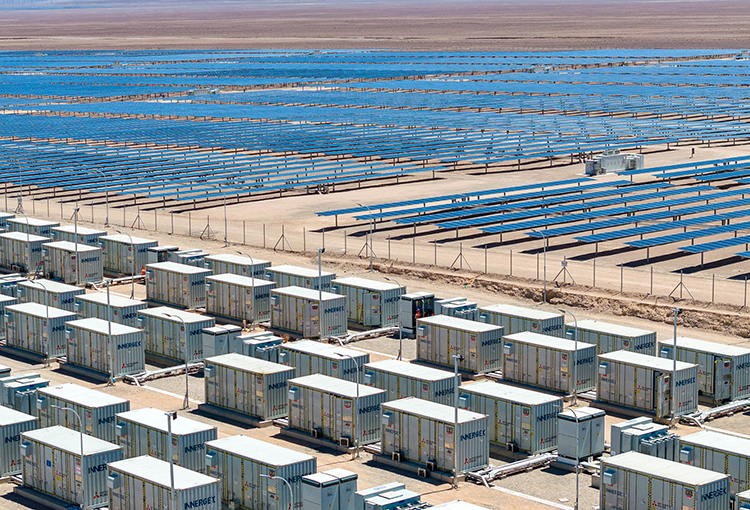
According to a document prepared by Colbún for Revista ELECTRICIDAD, “the presence of battery energy storage systems in the National Electrical System is increasing rapidly.” The company highlights that, according to information from the National Energy Commission (CNE), BESS projects in operation, construction, testing, and declared under construction total more than 10,000 MW, close to 25% of the SEN’s installed capacity. In Colbún’s case, the company is building and commissioning two BESS parks for a total of 456 MW and 1,824 MWh.
“BESS make it possible to better manage renewable generation surpluses, reducing curtailment and shifting energy to the hours when the system needs it most,” Colbún emphasizes. The generator adds that this “improves the efficiency of existing infrastructure and provides operational flexibility.” At the same time, it warns that “the incorporation of large-scale storage poses relevant technical challenges,” especially in integrating these assets into the system’s scheduling and coordination.
From a technical perspective, Jaime Solari, head of the Energy Sector for Latin America at SLR Consulting, maintains that “the challenges have evolved from purely energy-related aspects toward matters of behavior and operation of electrical systems with high renewable penetration.” Massive integration, he explains, requires “coordinating charge and discharge cycles, validating dynamic models, verifying the response to contingencies, and ensuring that operations do not aggravate local or zonal congestion.”
According to Solari, operators require “detailed representations of inverters, controls, operational limitations, and state-of-charge management strategies.” He also mentions that, in systems with low inertia, BESS take on a growing role in “frequency stability, rapid response to contingencies, and dynamic voltage support.”
For his part, David Ruiz de Andrés, CEO of Grenergy, highlights the role of storage in Chile and the region: “Today we are one of the top 3 international investors in Chile. With Elena, the largest battery plant in the Americas, we are driving a hub in the north based on clean and competitive energy for industry and for all Chileans.”
For the executive of the Spanish multinational, the process will have a positive impact on another of the company’s initiatives in the country: “That hub will be the foundation of Atacama Data, the data center we are developing in the north within our GR Data platform, through which we aim to attract close to US$25 billion in direct investment to the country.”
Beyond the development of new projects, Rodrigo Moreno, academic at Universidad Adolfo Ibáñez, director of the Enlace Energy Center, and head of the ISCI Energy Group, maintains that storage “profoundly” changes the operation of the system. “The state of charge links what happens in one hour with what may happen in the following ones,” he explains. Added to this is that “a single battery shifts energy over time, provides complementary services, and adds flexibility,” which “forces us to co-optimize energy and complementary services jointly.”
Grid stability is one of the main challenges. Moreno maintains that “it is necessary to take advantage of the capacity of BESS to ‘form the grid,'” providing synthetic inertia and grid strength. Northern Chile is especially relevant, “as it is an electrically weak zone with a very high concentration of power electronics.”
However, the academic stresses that batteries do not solve the problem on their own. “They must be complemented with other equipment, such as synchronous condensers, and we must better understand the correct composition of a portfolio that integrates several technologies,” Moreno states, emphasizing that “the underlying challenge is one of portfolio, not of installing a single type of equipment.”
In this context, grid-forming inverters become important. “Unlike grid-following inverters, which need a strong grid as a reference, the former actively impose voltage magnitude and angle,” mentions Rodrigo Moreno.
However, the academic warns that “it is not a magic solution. Challenges remain regarding control tuning and interaction between multiple units operating in parallel.” For SLR, moreover, the standards for GFM and GFL inverters are still under development in Chile. Manuel Merlino, head of Energy Advisory at SLR Consulting in Latin America, considers that “the guide published in 2025 on minimum technical requirements for grid-forming inverter-based resources constitutes a relevant step toward advancing their implementation in the country.”
Modeling remains one of the main gaps. Moreno states that there is “a significant gap in adequately representing the dynamic behavior of BESS. Representing these phenomena well requires electromagnetic transient (EMT) simulation, which is much more costly and difficult to apply to complete systems,” he explains. In addition, manufacturers provide “black box” models that are proprietary and difficult to validate, which is why “validated, interoperable, and standardized models are needed.”
Added to this, according to the academic, is a separation between economic planning and stability studies. The academic also identifies a separation between economic planning and stability studies: “The models with which we economically plan and operate the system and the models with which we study its stability live in separate worlds.” The challenge is to “couple optimization and simulation, incorporating stability and resilience metrics directly into decisions.”
The expansion of storage requires new regulatory and economic signals. Colbún argues that “the challenge is no longer solely to develop storage projects, but also to have a regulatory framework that allows the value these assets bring to the system to be fully captured.” The company considers it necessary to have “clear rules for the participation of BESS in the provision of complementary services.”
Along the same lines, Moreno agrees that “clear requirements in the regulations, validated models, and market signals that remunerate these stability services” are needed. Without that framework, he maintains, “technology alone does not deploy where the system requires it.”
For Colbún, BESS are “one of the central enablers of the second stage of the Chilean energy transition.” The company maintains that the challenge lies in “integrating and managing that energy” and responding to the robustness demands imposed by renewable expansion.
Looking ahead, Merlino projects “the consolidation of Grid-Forming controls,” the integration of multiple services in real time, and greater sophistication in modeling and digital operation. The conceptual change, he affirms, is that “BESS will cease to be considered solely as generation assets and will be designed as structural components of the electrical grid.”