
Enel Foundation, ISCI, and UAI academic developed an unprecedented study on the impact of the blackout in Chile
July 31, 2026
The study detected inconsistencies over time in the comparative analysis of methodologies for estimating the costs and social impact of massive electrical blackouts—episodes that are increasingly frequent in the context of greater energy demand and extreme natural events due to climate change. Professor Rodrigo Moreno, PhD and academic at the Faculty of Engineering and Sciences and at the Business School of Universidad Adolfo Ibáñez, led the study.
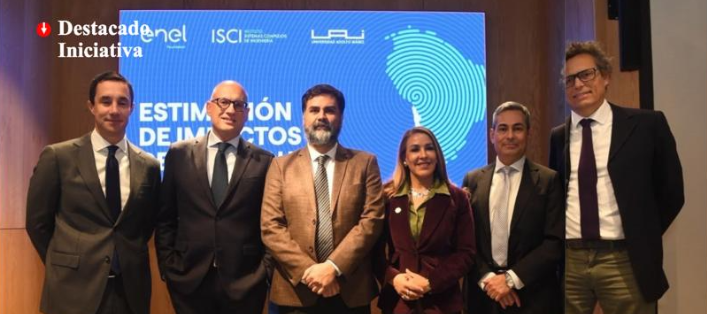
With the aim of generating evidence on the economic and social costs associated with large-scale power interruptions such as the massive blackout of 2025, and contributing to the discussion on the resilience of the electrical system in our country, Enel Foundation, the Complex Engineering Systems Institute (ISCI), and academic Rodrigo Moreno of the Faculty of Engineering and Sciences and the Business School of Universidad Adolfo Ibáñez presented the results of the study “Estimation of the Impact of the Blackout in Chile.”
Gianluca Palumbo, General Manager of Enel Chile, emphasized that the effects of climate change are not a concern for the distribution company alone, but a problem in which the entire sector must cooperate. “The reason we have worked on this study relates to the impacts on society. (…) Only by cooperating and demonstrating what the effects are and how we can change regulatory mechanisms will we be able to support the energy transition as Chilean society.”
Recalling the 2025 episode, Claudio Seebach, Dean of the Faculty of Engineering and Sciences at UAI, stated: “It is necessary to expand science and research on a complex engineering system like this one. It requires more than merely seeking to assign responsibility within the system; it also demands spaces for collaboration, and what better way to do this than through academia to find solutions that also allow us to restore or maintain confidence in a Chilean energy transition that is truly exemplary.”
On the occasion, Juan Carlos Jobbet, former Minister of Energy and current director of the Center for Business Solutions for Development at Universidad Adolfo Ibáñez, added: “This study is important because it puts security on the table for discussion and because it helps us prevent scenarios that erode the confidence of the actors in the electrical system, which is one of the essential pillars for advancing electrification and the fight against climate change.”
For her part, Giulia Genuardi, Director of Enel Foundation, valued the opportunity to act as a bridge between academia, industry, and civil society. “This study is very important because it helps us understand that there is no single methodology for analyzing all the aspects associated with the impact related to energy. We must integrate several methodologies to understand the economic, industrial, and social impacts.”
Electrical blackouts generate significant economic costs for society, mainly due to the loss of industrial productivity. The study seeks to estimate the Value of Lost Load (VOLL) in Chile, known as the unit cost of failure, and to apply these results to the blackout event of February 25, 2025.
The analysis focuses on direct monetary costs, additionally incorporating the valuation of loss for households.
The author of the study, doctor of engineering Rodrigo Moreno, academic at the UAI Faculty of Engineering and Sciences and at the UAI Business School, highlighted the importance of handling interoperable methodologies and information, and specified: “In the long term, infrastructure is evidently calculated through the cost of failure determined by the study of the National Energy Commission. Therefore, it is very important to have a calculated, solid, robust, justified value, and one that does not undergo many variations over time, because they are precisely a signal for delivering infrastructure in the long term.”
In a peer review of the study, Mauricio Funes, Executive Secretary of the National Energy Commission (CNE), added that: “the cost of failure makes it possible to incorporate the value of supply continuity within the cost/benefit analyses that underpin many of the regulatory decisions we adopt.”
For his part, Mirko Armiento, Senior Researcher at Enel Foundation, specified that although the February 2025 blackout revealed the magnitude of the associated costs (estimated between 800 million and 1 billion dollars) and the need for lasting solutions, “(…) beyond the exact figure, the message is that resilience has value—not only economic, but also social and strategic. (…)”
At the close of the event, participants concluded that the resilience of an electrical system is not measured solely by its capacity to respond when a contingency occurs. It is also measured, and perhaps more than ever, by our capacity to learn from it.
Download the study at the following link: https://www.enelfoundation.org/all-news/news/2026/07/impacts-blackouts-in-chile-isci-enel-foundation