
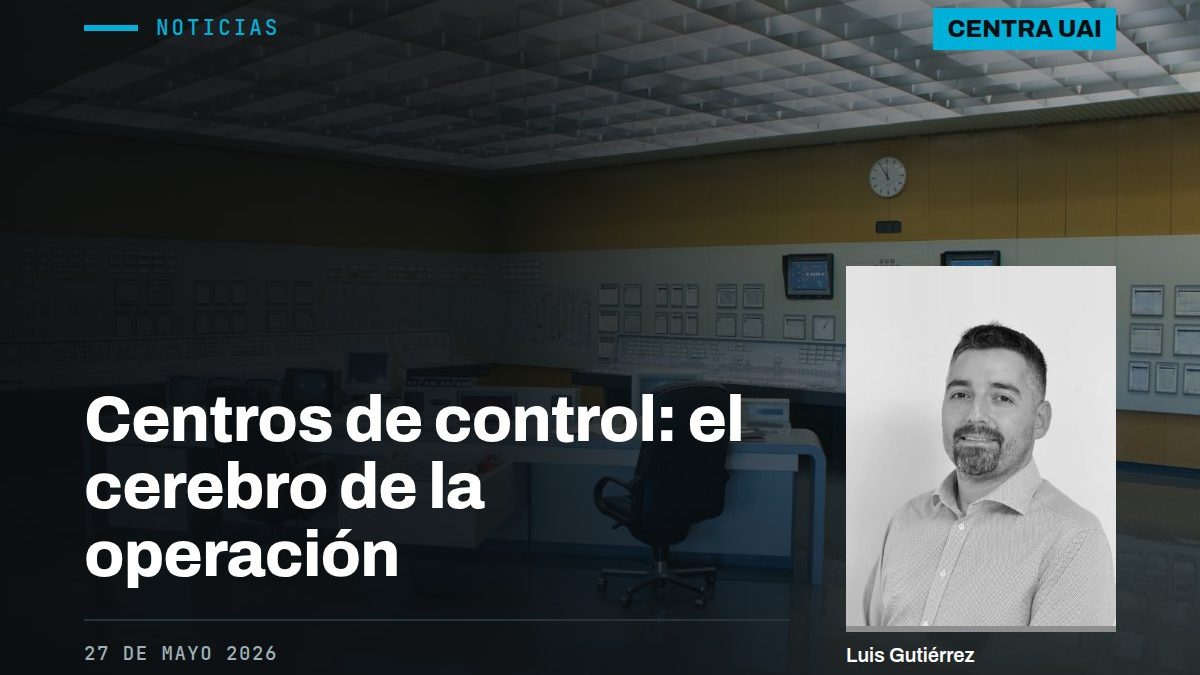
Control centers: The brain of the operation
May 27, 2026
NEW TECHNOLOGICAL TOOLS ALLOW FOR STRENGTHENING MONITORING, MANAGEMENT, AND RESPONSE TO CONTINGENCIES.
Integrated remote control and operation centers have become key pieces to safeguard the continuity and stability of the electrical system.
In the view of Leonardo Prado, Director of Operations at ISA Energía, this is possible because advances in technology and artificial intelligence “put within our reach different solutions and support tools for operators’ decision-making, decisions that in real-time can optimize the operation of the electrical system with better performance in terms of safety, economy, and operational efficiency.”
This is complemented by Eduardo Amaro, Head of the Command Center at Chilquinta Distribución, who states that thanks to the advancement of technology and communications, “from the control center we can monitor different points of the network in real-time, verify operating conditions, such as line transfer levels, system voltage levels among others. Thanks to the automation and segmentation of the network, we can better coordinate resources in the field and reduce response times to contingencies.”
Regarding its benefits, the Chilquinta executive provides an example: “Faced with the operation of a protection on a Medium Voltage feeder, the first control on the impact to customers is the segmentation or selectivity of the system, that is to say, only a portion of the total customers is affected; secondly and automatically, the network reconfigures itself, isolating the fault sector in less than a minute. At the same instant, the operator quickly takes control of the situation by analyzing more customer transfer alternatives, with the goal of minimizing the impact by executing remote maneuvers when tele-controlled equipment exists and directing brigades more precisely to the probable fault point.”
Know and operate
For Luis Gutiérrez, professor at the Faculty of Engineering and Sciences and academic at the Energy Transition Center of the Adolfo Ibáñez University (UAI), the blackout on February 25, 2025, illustrates the cost of operating without integrated visibility.
“The EPRI report commissioned by the National Electrical Coordinator (CEN) showed that during the restoration it was not possible to accurately know the network topology due to a lack of visibility and control, which forced the coordinated companies to physically send operators to remote substations. Moreover, from the CEN’s operation reports, it is evident that the Scada system became unusable, frozen, and that even telephone communications were affected,” he mentions.
“Maneuvers that with a robust Scada would have taken minutes, consumed hours, significantly delaying the recovery of supply. In a system of more than 3,000 kilometers, with many substations that normally operate unattended, integrated real-time visibility is not an operational advantage but a basic condition for safe and efficient operation,” he adds.
Precisely, the strengthening of these capabilities appears today as one of the main challenges for the electrical system.
In a context marked by the growth of renewable energies, greater operational complexity, and new continuity demands, having real-time supervision capabilities allows optimizing the management of critical infrastructure and improving the response capacity to contingencies, detecting anomalies or faults before they escalate. This is highlighted by Cristián Vera, Head of Real-Time Operation at ISA Energía, who comments that “the consolidation of the infrastructure of a Control Center allows supervising hundreds of substations and transmission lines simultaneously, eliminating the permanent need for personnel in each facility.”
In that scenario, he highlights the Control Center that the company has, which “was designed precisely to strengthen the supervision and operational coordination of strategic assets of the Chilean electrical system, incorporating advanced standards of security, monitoring, and operational continuity.”
Strengthening
The electricity sector is moving towards increasingly intelligent, predictive, and flexible operations.
Along these lines, technological integration and data processing capacity acquire an increasingly strategic role.
Given this, “Integrated Operation & Control Centers (CIOC) are the convergence point of OT and IT that transforms operational data into high-impact decisions, they are the single source of truth for planning, operation, and maintenance; they are the future of the operation of the electrical networks of the future,” explains Ernesto Uribe, Sales Manager at Siemens.
In terms of efficiency, the multinational’s executive highlights the fact that these facilities enable “the location and restoration of faults in less time, which represents a lower impact on the operation of critical industrial processes, reducing manual intervention with fewer operational errors and dependence on on-site personnel, maximizing the use of OPEX throughout the CIOC lifecycle.”
“Without integrated centers, the operational complexity of this new energy paradigm would be unmanageable,” adds Uribe.
Along with operational capabilities, another of the focuses emerging strongly is the preparation of networks for more complex and exposed scenarios.
Faced with an electrical system that is incorporating more distributed generation, electromobility, storage, and new continuity demands, Eduardo Amaro mentions that control centers “must integrate more data analytics, automation, forecasting, a higher degree of cybersecurity, and advanced network management tools. Technology will be fundamental, but the real challenge will be to combine that technological capacity with human teams prepared to make quick, safe, and coordinated decisions in increasingly dynamic and demanding scenarios.”
On the other hand, the UAI academic warns that the digitization enabled by integrated control centers also expands the attack surface, and that balance must be explicitly managed.
“We should expect that in the future, hopefully not too distant, distribution networks will also have a good level of visibility to improve response times to faults, activating automation mechanisms and dispatching crews proactively,” Gutiérrez highlights.
This is shared by Leonardo Prado, who recalls that “we must not leave aside the cybersecurity perspective, as they know every door we open can mean new vulnerabilities, which must be reviewed and mitigated.”
Meanwhile, for Ernesto Uribe, the next step of a CIOC is “its transformation into a nexus of coordination and transition for adaptive and bidirectional networks, capable of anticipating, adapting, and optimizing the operation of complex electrical systems in real-time, guaranteeing resilience, sustainability, and efficiency in a context of high uncertainty.”
Courtesy of Revista Electricidad