
Power system flexibility is also a regulatory issue
October 29, 2026
Revista Electricidad devoted the cover story of its October issue (No. 319) to flexible electricity markets and the new business models emerging around them. Four specialists discussed the current and future flexibility of Chile’s National Electric System, among them José María Cruz, head of the UAI Center for Energy Transition (CENTRA).
Cruz noted that Chile has already completed its first transition: about two thirds of the electricity generated in 2025 came from renewable sources. However, the system still lacks the flexibility needed to fully integrate it, and more than 6,000 GWh of renewable energy were curtailed that year. He pointed to three limiting factors: insufficient transmission to carry solar generation from the north, an operation designed around dispatchable generation, and demand that barely responds to prices.
To move forward, he proposed working on three fronts: dispatch tools that value the opportunity cost of stored energy, clearly defined roles for the system operator, distribution companies and aggregators to make use of distributed resources, and electrification of transport, heating and cooling and industry designed from the outset as flexible demand. “Flexibility is not solved just with more megawatts of storage: it is also a regulatory issue,” he said.
Among the business opportunities, he highlighted large-scale storage in the north and, as the next step, aggregation through virtual power plants, which integrate distributed generation, storage and flexible loads from multiple customers and operate them as a single unit vis-à-vis the grid and the market.
The article also features the views of Carlos Suazo (SPEC), Pilar Bravo (Zebra Energía) and Christian Scholz (EnergiE).
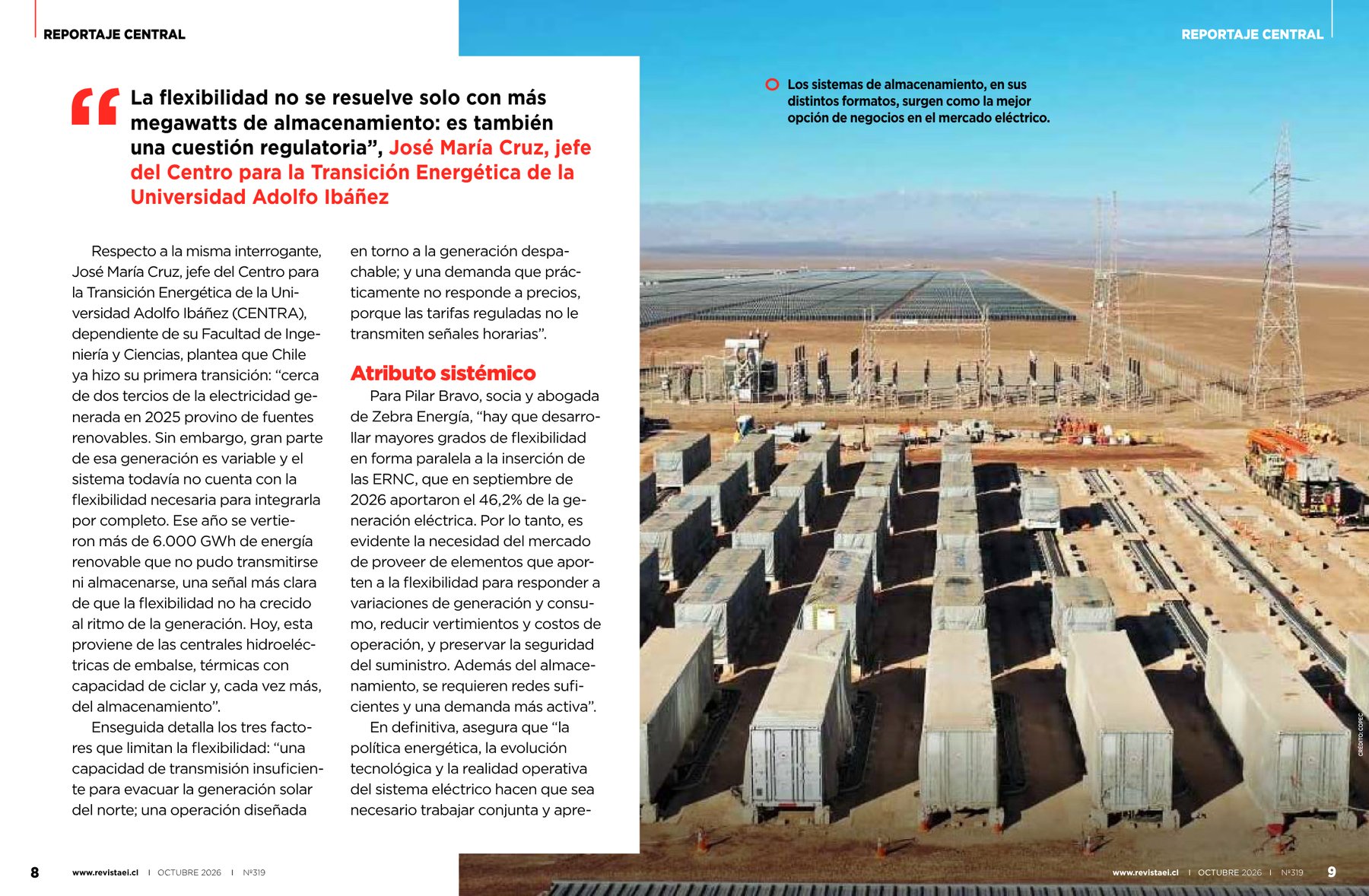
Courtesy of Revista Electricidad. See original article.