
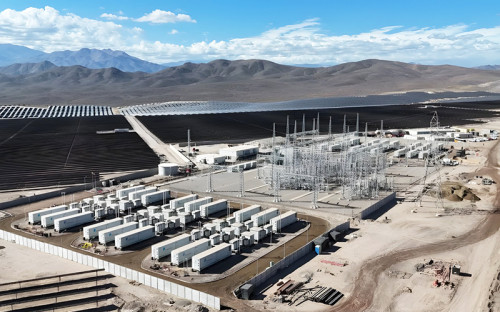
BESS project rollout in Chile: Operational, regulatory, and market challenges
October 2, 2026
Industry specialists stress that maximizing the storage impact on the system requires optimal management of these assets. Only a coordinated integration of projects will make it possible to leverage their attributes to strengthen grid resilience.
There is no doubt that battery energy storage systems, known as BESS (Battery Energy Storage System), have become the indispensable enabling condition for the energy transition and decarbonization in Chile. Currently, with more than 2,500 MW of storage capacity in operation in the National Electric System (SEN) and projections pointing to more than 10 GW by 2028, it is necessary to address the most pressing challenges facing storage projects in the country.
Part of these challenges, according to Juan Carlos Madrigal, academic in the Department of Energy Technologies at the Universidad de Atacama, has to do with a temporal asymmetry between the rapid installation of a BESS, “which takes no more than two years from approval, and the construction of electric transmission systems, which can take between 5 and 10 years, making it difficult to meet the expansion goal for these projects.”
Regarding the difficulties of connecting projects to the transmission grid, Javier Bustos, academic at the Centro de Regulación y Competencia of the Universidad de Chile and associate consultant at Domo Legal, highlights the importance of assessing whether the amendments to the transmission regulations currently under review at the Comptroller General’s Office (Contraloría) will be enough to resolve these problems.
Bustos adds that one of the long-term challenges is the reliance on an administratively set remuneration scheme that does not respond to market signals. “This tariff rigidity has encouraged a rapid concentration of investments in 4- to 5-hour batteries in the same geographic areas, creating an imminent risk of over-installation that will end up flattening price arbitrage and eroding the profitability that sustains the business model.”
For Bernardo Severino, head of studies at the UAI Energy Transition Center, the main challenge for these assets lies in how they are managed within the system’s operation. “As their number grows, we must coordinate many batteries simultaneously, taking advantage of their flexibility and their ability to shift energy over time. That is why the National Electric Coordinator (CEN) must use scheduling and operation tools capable of managing that complexity and obtaining the greatest possible value for the system.”
OPTIMAL AND EFFICIENT OPERATION
The massive incorporation of storage systems into the SEN requires optimal and efficient operation by the CEN. According to Severino, the Coordinator should move toward a scheme of rolling-horizon stochastic pre-dispatch and dispatch.
This approach combines two pillars: “Rolling horizon, which means that at each moment the operation is optimized over a future time window, only the immediate decision is executed, and then the problem is solved again with updated information; and stochastic, which means that within that optimization, different future scenarios and their probabilities are explicitly considered (…) with this scheme, the aim would be to estimate the opportunity cost of the stored energy,” Severino explains.
In the opinion of Juan Carlos Madrigal, opportunity cost is key: “a battery does not have a conventional variable cost comparable to that of a thermal plant, so dispatch should reflect the expected value of conserving energy for moments of greater scarcity, congestion, or operational need, which would avoid premature discharges, improve the price signal, and steer charging toward hours of renewable surplus, effectively helping to reduce solar and wind curtailment in practice.”
In this regard, Javier Bustos explains that the underlying problem is that a battery’s opportunity cost is very difficult to model and audit: “if the CEN calibrates it poorly, dispatch may end up maximizing private rent without improving operation, or leaving curtailed energy and underused batteries at the same time. In this sense, he considers that the definitive solution for calculating opportunity cost “is to leave it to the facility owners, through participation in a bid market with a binding day-ahead commitment.”
BATTERY ATTRIBUTES
Beyond shifting energy between hourly blocks, storage systems are called on to deliver critical attributes of stability, strength, and security to the grid, especially as the conventional generation fleet is progressively phased out.
However, Juan Carlos Madrigal states that for this to happen, “it will be necessary to move from a logic of batteries as arbitrage assets toward a logic of grid-forming and stabilizing resources. Grid-forming inverters can provide synthetic inertia, dynamic voltage support, fast frequency response, the ability to operate in weak grids, and eventually restoration services.”
For his part, Bernardo Severino adds that the opportunity lies in taking advantage of the great flexibility of electronic converters. “Even a grid-following converter, with appropriate controls and parameters, can deliver fast responses to voltage and frequency disturbances. Meanwhile, grid-forming converters represent one of the most relevant lines of technological development in this area and will probably play a growing role as system strength declines.”
However, the contribution of storage to system stability is not automatic and requires technical caution, warns Javier Bustos: “If the generation that is stored in batteries is predominantly grid-following, adding more batteries without grid-forming inverters only weakens the system even further (…) which is why it is necessary for both regulation and market design to provide the right framework so that investments are made in a timely manner.”
THE RISK OF OVERSUPPLY
With projections pointing to more than 10 GW of storage by 2028, the mass deployment of batteries could flatten nighttime marginal costs and reduce the arbitrage margin. This potential oversupply scenario raises doubts about the future profitability of investments and the financial viability of some projects, such as stand-alone ones.
In this regard, Juan Carlos Madrigal explains that “the risk of oversupply exists, but it should not be understood solely as an excess of installed megawatts, but as a concentration of projects with similar technical profiles. To mitigate that risk, the business model will need to diversify toward ancillary services, capacity or resource-adequacy contracts, hybrid solutions with renewable generation, coverage for free clients, congestion management, and resilience services.”
So far, Javier Bustos explains, the main lever of bankability in Chile has been the transitional regime of DS 70, which established a stable revenue floor as an incentive, but he noted that “that ends in 2034 and should not be extended, so it is to be expected that the stand-alone battery model will become less preferred by investors, giving way to more hybrid projects that can participate in the contracts market or be incorporated into a diversified portfolio of generators with contracts.”
Courtesy of Revista Nueva Minería y Energía. Read the original article in the October 2026 issue (page 68, in Spanish).