
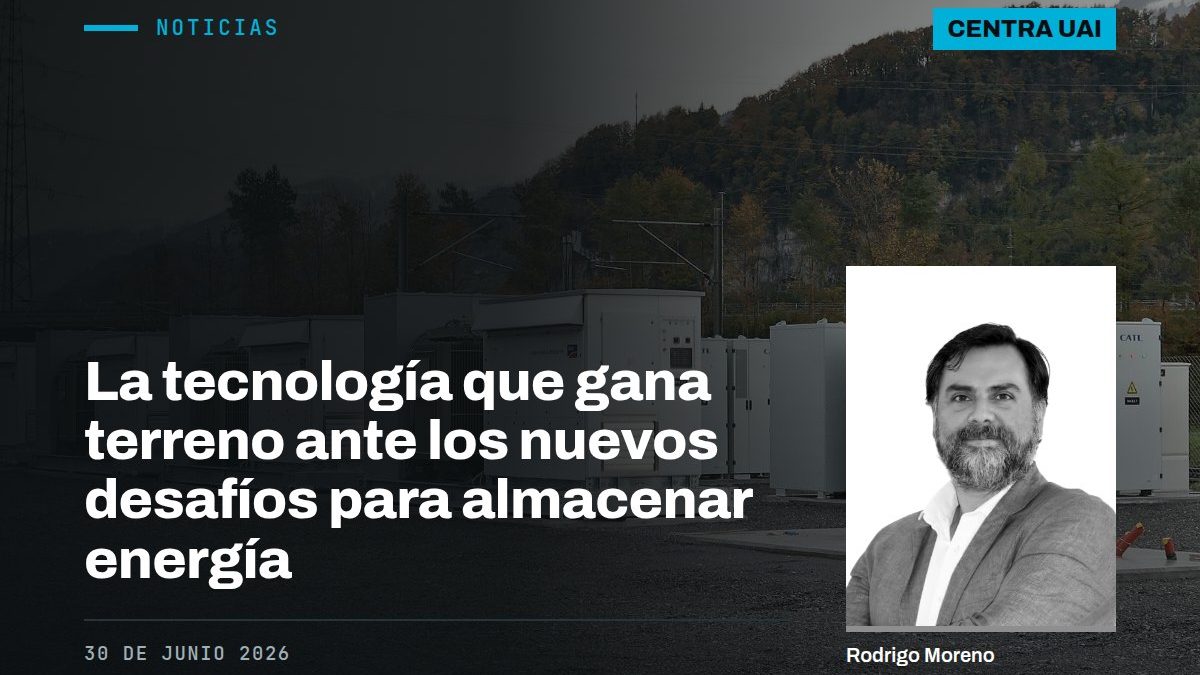
Technology that is gaining ground in the face of new challenges to energy storage
June 30, 2026
BESS systems provide flexibility, stability, and backup to the electrical system. Experts highlight that their development will allow the integration of more renewable energies and reduce operating costs.
In addition to storing energy, BESS (Battery Energy Storage Systems) have consolidated themselves as a key tool to accelerate the energy transition. Their versatility allows them to fulfill multiple functions, from containing renewable generation surpluses and reducing the need for thermal generation during peak hours, to providing backup during power outages and adding flexibility to the electrical system.
“BESS are seen today as an enabling technology to accelerate and achieve the goals of the energy transition,” highlights Rodrigo Palma, an academic from the Electrical Engineering Department and researcher at the Energy Center of the University of Chile.
He adds that these systems can also reduce the curtailment of renewable energy during peak solar generation hours in the north of the country and increase household resilience against power outages.
For Ana Lía Rojas, executive director of Acera, this contribution takes on special relevance in a scenario of high penetration of renewable energies and the progressive retirement of conventional power plants.
“BESS are beginning to play an increasingly important role not only in energy arbitrage but also in the provision of ancillary services for frequency control,” assures the executive director of Acera, Ana Lía Rojas.
In this context, she explains, the system requires inverter-based technologies to provide grid strength attributes previously delivered by synchronous machines, such as inertia and short-circuit power.
“In this sense, BESS are beginning to play an increasingly important role not only in energy arbitrage but also in the provision of ancillary services for frequency control, historically dominated by thermal and hydraulic units,” assures the Acera director.
Rodrigo Moreno, an academic from the Faculty of Engineering and Sciences and the Business School of the Adolfo Ibáñez University, explains that, being a resource based on power electronics, BESS respond with great speed, which allows them to cover practically the entire chain of ancillary services of the National Electrical System. This includes frequency control, voltage control, and more advanced functions such as fast frequency response (FFR), synthetic inertia, and grid strength through grid-forming control.
The academic maintains that the economic value of these capabilities can be enormous:
“In markets like California, batteries saturated the ancillary services markets. If we calculate that the demand for all frequency ancillary services in Chile, aggregated, is no greater than 1 GW and the installed capacity in BESS in the medium term would reach 9 GW, the potential savings in operating costs for the system would be very significant.”
Rojas agrees with this diagnosis, and adds that as renewable participation increases, the opportunities are no longer just in injecting or shifting energy, but also in providing flexibility to the system. “This opens up spaces in the provision of new ancillary services, applications associated with grid congestion management, ramp management, operational backup, and more robust supply solutions for unregulated customers and electricity-intensive sectors,” she declares.