
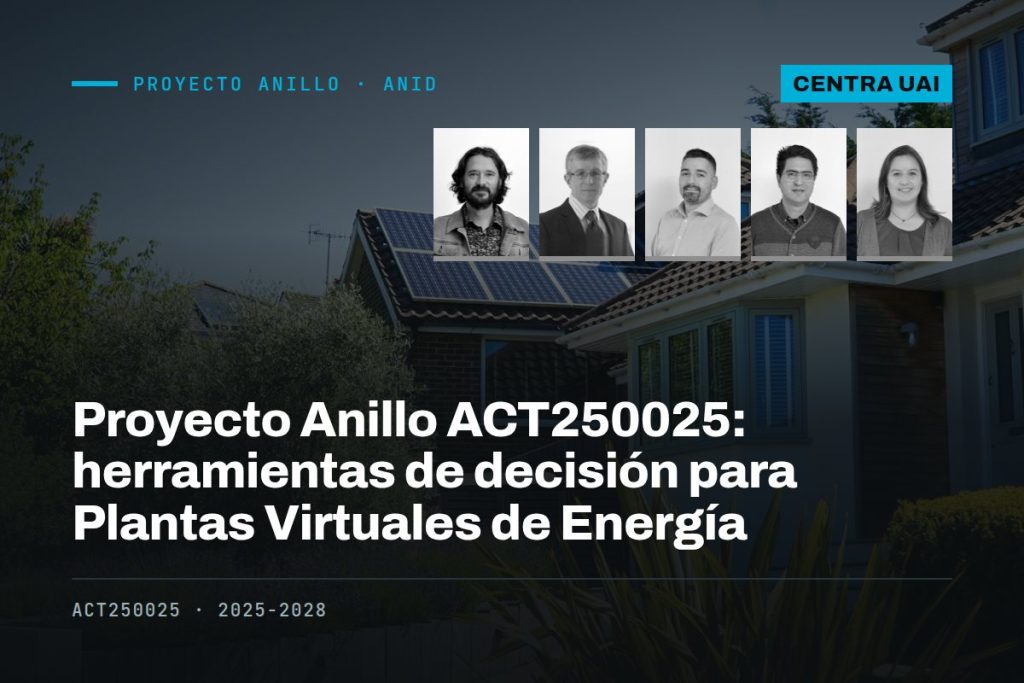
Anillo Project ACT250025: Decision Support Tools for Virtual Power Plants
Anillo Project ACT250025: Decision Support Tools for Virtual Power Plants
Models and platforms to plan, operate and integrate Virtual Power Plants (VPPs) into Chile’s grids and regulation, focusing on efficiency, resilience and consumer participation.
VisiónDERRED web platform for efficient integration of distributed energy resources
Web platform that assesses in hours how much distributed generation each point of Chile’s distribution networks can host. FONDEF IDeA R&D project ID24I10476, carried out by CENTRA UAI with ACESOL as partner.
EDF Power Solutions and Centra UAI discuss the future of energy storage in Chile
November 17, 2025 A seminar brought together industry experts to analyze the prospects for this technology in the coming years. Analyzing the future of energy storage as a key enabler for a secure energy transition was the objective of the seminar “The Storage Boom: Challenges and Opportunities,” organized by EDF Power Solutions and the Center for Energy Transition (Centra) of the Faculty of Engineering and…
Integrating predictive and prescriptive approaches in stochastic optimisation
Models that merge forecasting and decision-making in a single step, to measure directly how forecast quality affects the decision taken.
Anillo Project ACT192094: adapting energy systems to climate change
Methods and models for government and companies to plan energy systems and markets under the uncertainties and risks of climate change.
GEMA: smart energy management for microgrids with storage
A system that learns each user’s generation and consumption patterns and decides when to store, use or export solar energy to the grid.
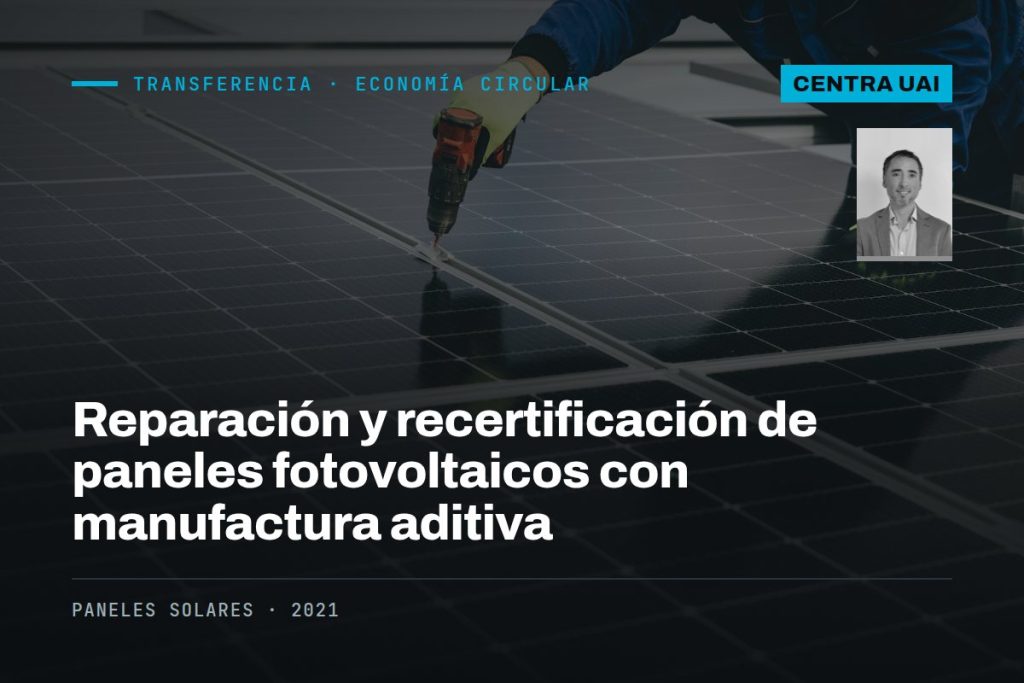
Repair and recertification of silicon photovoltaic panels using additive manufacturing
This project consists of evaluating the health status of photovoltaic panels installed in Chilean territory and contributing to the management of waste from defective panels. This involves the identification of operating cells in waste panels, their disconnection and subsequent reconnection in repaired panels, for subsequent recertification, by printing organic inks with conductive properties based on metallic nanoparticles.