A Chile energy transition expert talks pumped storage
August 17, 2026
While energy storage investment in Chile to date has been channeled almost exclusively into lithium-ion battery systems, pumped storage is blinking on the radar again.
A US$900mn project – 450MW Atacama, linked to French firm Hyvity – is in the environmental review phase and Chilean generator Colbún’s US$1.4bn, 800MW initiative Paposo is still in the company’s portfolio.
A US$1bn, 300MW pumped storage project – branded Espejo de Tarapacá and belonging to Valhalla – was presented in 2014 but canceled a few years ago, according to information in the BNamericas database.
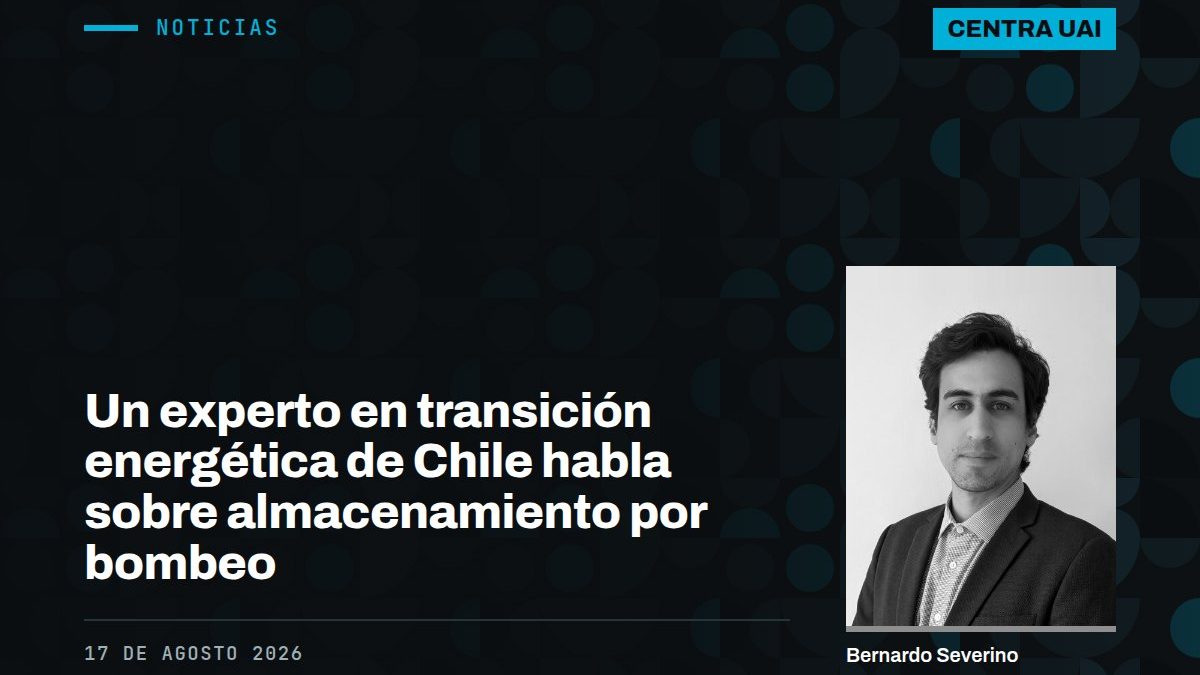
To discuss the technology and explore why the segment has not yet gained traction, BNamericas spoke with Bernardo Severino, research chief at Universidad Adolfo Ibáñez’s energy transition center CENTRA.
BNamericas: What would be the benefits of having a pumped hydro storage plant in Chile?
Severino: The main benefit would be having long-duration storage available to shift renewable energy between days. This would reduce the use of gas- or diesel-fired generation during prolonged periods of low solar or wind output, lower operating costs, and contribute to the power system’s adequacy and resilience. In addition, a pumped storage plant can provide flexibility services and support daily operations.
To understand this contribution, it’s necessary to consider how this technology works. A pumped storage plant stores energy by pumping water from a lower reservoir to an upper one, then recovers it later through turbines. In simple terms, it functions as a hydraulic battery. Its main advantage is that the plant’s power output – determined by the generation and pumping equipment – can be sized with relative independence from its energy capacity, which is linked to the reservoirs’ useful volume. This greater decoupling makes it easier to develop projects with 12, 24 or more hours of duration, whereas increasing duration in BESS requires proportionally more battery modules.
The systemic relevance of this type of storage was analyzed in the study “Analysis of the Integration of Long-Duration Energy Storage Systems into the National Electric System,” developed by Universidad Adolfo Ibáñez’s energy transition center CENTRA, together with EDF power solutions Chile, under the CENTRA-EDF Industrial Research Chair. We assessed different long-duration storage technologies, including pumped hydro storage plants, using a planning model that incorporated chronological multi-day sequences. This representation allowed us to capture the value of shifting large volumes of energy between periods of renewable abundance and scarcity. In the scenarios analyzed, the addition of long-duration storage mainly reduced thermal dispatch and operating costs. One of the central findings is that modeling based solely on isolated typical days can represent intraday arbitrage, but underestimate the value of moving energy between days.
Pumping does not produce net energy, since losses occur during the charge and discharge cycle. Its benefit shows up when it helps avoid higher costs associated with gas- or diesel-fired generation, renewable curtailment, thermal unit start-ups, shutdowns and cycling, or additional backup or transmission investment. Its value should therefore not be assessed solely by the hourly price differential, but also by its contribution to reducing the system’s total operating and investment costs, improving energy adequacy, and lowering exposure to imported fuels.
Once built, the plant is also not reserved solely for periods of scarcity. It can carry out intraday arbitrage and provide reserve services, frequency regulation, voltage control and contingency support. Depending on their configuration and operating mode, synchronous units can also provide inertia and short-circuit power. Its strategic attribute, however, remains its ability to deliver large volumes of energy over longer periods than those typically covered by BESS.
BNamericas: Chile appears very well suited for such plants, given its geography (mountains close to the coast, etc.). What’s your take?
Severino: Chile has favorable geographic conditions for developing pumped storage plants, mainly due to its elevation differences and the proximity between elevated areas, zones with high renewable generation, and the grid. This assessment isn’t based solely on a general observation of the country’s geography.
A study carried out under cooperation between GIZ and the energy ministry identified, through geospatial analysis, numerous potential sites for pumped storage plants in Chile, both coastal and inland, with two reservoirs. Based on these findings, the ministry quantified and filtered the pumped storage potential to incorporate it into the 2023–2027 Long-Term Energy Plan (PELP), where this technology was considered a candidate alternative for the northern zone of the National Electric System. This confirms that Chile has relevant, already-identified geographic potential, although each site requires specific studies to determine its feasibility.
However, the sites detected correspond to preliminary potential and not necessarily to projects with demonstrated feasibility. For a site to become a project, there also needs to be adequate grid connection, a storage need in that area, and economic, environmental and territorial conditions that allow it to be developed.
BNamericas: Setting aside the permitting issue, is there any consensus in the local power sector on why such plants don’t yet exist in the country?
Severino: Setting aside permitting, I wouldn’t say there’s yet a clear consensus in Chile’s power sector. Long-duration storage has received less attention than lithium-ion batteries, and there are still few local studies on its implementation conditions, business models, and contribution under different operating scenarios.
However, based on the study we carried out at CENTRA together with EDF power solutions Chile, it’s possible to identify some barriers.
The first is that the need for long-duration storage is relatively recent and is not yet perceived as urgent. For much of the Chilean system’s development, flexibility was provided by reservoir hydroelectric plants and dispatchable thermal generation. With the growth of solar and wind generation, the need for storage has increased, but so far the most visible problem has been intraday balancing, which four- or five-hour batteries can address. The value of shifting large volumes of energy between days is not yet clearly reflected in investment signals.
Added to this is a methodological limitation. If planning uses isolated typical days or periods without sufficient chronological continuity, it can adequately represent a battery that charges and discharges within the same day, but underestimate a technology whose value emerges from moving energy between several days. Our study showed that long-duration storage began to show value when the model incorporated multi-day sequences of renewable abundance and scarcity.
This potential bias can create a knock-on effect in the discussion around supply security. If the PELP doesn’t adequately highlight the value of long-duration storage, these technologies also tend not to be considered as alternatives in subsequent analyses. Mitigation measures end up concentrated on gas, diesel, watershed management and other operational actions, while storage’s potential to address multi-day events is left out of the assessment.
There is also a significant information gap. Chile still lacks detailed studies on the frequency, duration and severity of so-called “renewable droughts” – prolonged periods of low wind, solar, or combined generation. It’s also necessary to study how these events could evolve under climate change scenarios and extreme weather conditions. Without that information, it’s difficult to accurately estimate how much long-duration storage the system will need, in which areas, and for what duration.
On financing, our study did not identify a structural missing-money problem. Under the model’s assumptions, revenue from energy, capacity and ancillary services allowed investment to be recovered. However, that result assumes optimized intertemporal dispatch and accurate valuation of the opportunity cost of stored energy.
In practice, it’s still not entirely clear how these assets will be dispatched, how their state of charge will be managed, or how predictable their revenues will be. Nor is there explicit remuneration for their contribution to resilience against prolonged events – a value that isn’t necessarily reflected in daily arbitrage or in current capacity and ancillary services mechanisms.
So, rather than a consensus on a single barrier, there are several dimensions that still require further analysis. Our study allowed us to quantify the systemic value of long-duration storage under different scenarios, but it’s still necessary to deepen understanding of aspects such as the characterization of renewable droughts, their future evolution, dispatch design, state-of-charge management, and remuneration for contributions to resilience.
Courtesy of BNAmericas