
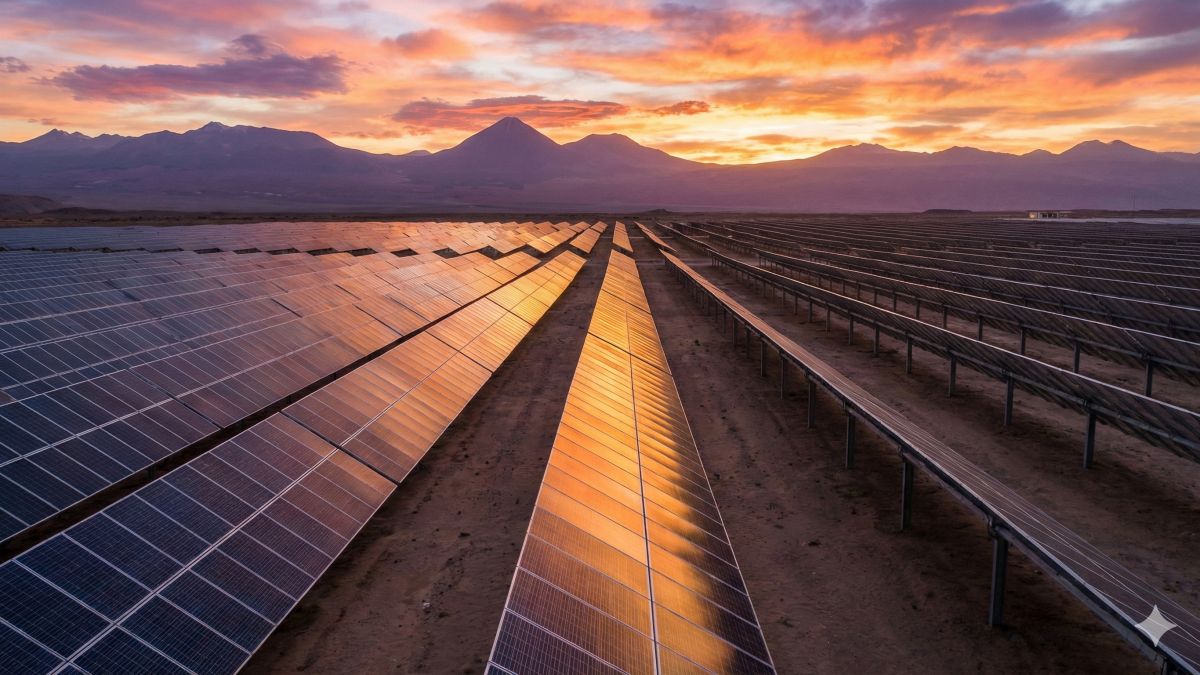
Chile prepares for the replacement and valorization of its photovoltaic panels.
December 1st, 2025
After more than a decade of accelerated growth, Chile is beginning to face its first structural questions regarding the circularity of its photovoltaic panels. By 2040, a massive replacement is projected, along with the need to establish clear pathways for their reuse, repair, and recycling. Although circular economy principles are already present in sector practices, regulatory gaps, high logistics costs, and a lack of infrastructure to process modules at scale persist. In an interview with Revista ELECTRICIDAD, representatives from the industry, research centers, and specialized organizations agree that the country is making progress, but requires an integrated strategy that connects regulation, technical capabilities, and new value opportunities.
The energy transition is giving way to a stage where circularity takes on a leading role in the solar industry. With an installed fleet that already exceeds a decade and a replacement projected toward 2040, the sector is facing challenges related to design, recovery, and end-of-life treatment of modules.
Acesol warns that progress is real but still insufficient. Danilo Jara, director of regulation and public policy of the association, highlights that “the circular economy is already present in the discourse and in several sector practices, but we are still in an initial phase if we compare it with the magnitude of the installed solar fleet.” He adds that companies have implemented improvements in waste management and onsite efficiency, although “significant gaps persist regarding the end-of-life of panels, which still lack a clear and economically viable pathway for valorization.”
The solar energy association representative emphasizes that transportation and treatment costs become higher due to current regulations: “Photovoltaic panels are classified as hazardous waste, and as long as that does not change, it will be very difficult to develop a local repair or recycling industry that can operate competitively.”
Regarding the REP Law, Jara believes that “it moves in the right direction, but still requires adjustments to be applicable in practice to the solar sector.” He states that allowing the recertification of repaired modules would be key to preventing functional materials from ending up in final disposal sites.
Designs to last and be recycled
From the manufacturing side, TrinaSolar argues that circularity must be incorporated from the beginning of the production chain. Its Product Manager PV Modules, Harison Franca, explains that “most of the materials that make up our modules are intrinsically recyclable and can be reincorporated into various applications, such as the aluminum frame, which maintains high added value even after decades of use.”
The specialist highlights technological advances that “enable performance guarantees of up to 30 years and better preserve efficiency over the long term.” According to Franca, the company is also developing concrete initiatives: “We presented our first fully recycled module and have recycled thousands of tons of packaging materials across our global operations, reducing impact from the source.”
Franca identifies a global trend: the complete life-cycle assessment, where manufacturers must demonstrate that their technology not only generates clean energy but can also be reincorporated into the productive system.
Infrastructure, regulations, and new opportunities
For Fundación Chile, the challenge requires anticipation. Ignacio Santelices, the organization’s Sustainability Manager, states that “the country must prepare for a massive replacement of panels toward 2040 and develop infrastructure that can recover their value, either by giving them a second life or recycling them with advanced technologies.” He also emphasizes that “it is essential to declassify them as hazardous waste, which currently hinders any initiative for reuse, repair, or recycling.”
Santelices highlights the potential of photovoltaic materials: “Up to 95% of a panel’s components can be recycled if we develop the proper industrial capabilities.” Chile already recycles glass and aluminum, but “the biggest challenges lie in silicon, silver, and polymers, which require more sophisticated processes and greater technological investment.”
He warns that with an adequate strategy, “a new value chain could emerge that would generate jobs, technical knowledge, and a strategic role for Chile in the global energy transition.” Without progress, he notes, the country risks depending on foreign recycling and losing economic opportunities. “Most of the materials in the bill of materials (BOM) of our photovoltaic modules are intrinsically recyclable and can be reincorporated into different applications at the end of their useful life,” adds Harlson Franca, Product Manager PV Modules at Trinasolar.
Public policy opportunity
From CENTRA-UAI, academic and head of the Center for Energy Transition, José María Cruz, assesses the challenge. “Chile currently operates with more than 22 million panels, and that figure will quadruple by 2030,” he states. His estimates suggest that the country could exceed “500 thousand tons of photovoltaic waste in the next decade and approach one million tons by 2050.”
He notes that the regulatory framework must be modernized: “We are still using standards designed for hazardous waste that do not differentiate between a panel that still functions, a repairable one, and one that is truly waste. This prevents any industrial-scale reuse or refurbishment.”
He also highlights that many modules could continue operating: “After 25 or 30 years they retain between 75% and 85% of their capacity, enabling use in lower-demand applications if they are properly tested, classified, and tracked.”
Electrification: extending useful life as a strategy
In the field of electrical infrastructure, ABB explains that the circular economy must also apply to switchgear, panels, and distribution systems. José Hernández, Service Sales Manager at the company, explains that “we promote modularity and repairability so that components can be upgraded or replaced without discarding the entire unit.”
Regarding extending useful life, Hernández states that “modernization and refurbishment are not only viable but preferable to full replacement. We can extend the life of distribution infrastructure by 20 to 30 years and reduce operating costs by up to 30%.” He adds that this strategy prevents “catastrophic failures such as arc flash, whose cost can be ten times higher than scheduled maintenance.”
The ABB representative further emphasizes the role of digitalization, noting that “predictive monitoring makes it possible to detect degradation before it causes major failures and to plan interventions only when necessary.” This, he mentions, contributes to waste reduction and more efficient operation throughout the equipment lifecycle.